

Computer Vision Software Developer in Germany
June 24, 2026
Mechatronics Technician – Machine Build & Test | Bowdon, GA, USA
August 14, 2026Turning Medical Inspection into Measurable ROI with Taymer’s Vision Systems
Medical device inspection is no longer just a final quality checkpoint—it is a critical driver of throughput, cost control, compliance, and customer satisfaction. For manufacturers producing catheters, balloon tubing, braided tubing, and other precision medical components, inspection performance directly impacts yield, labor efficiency, and time to market.
Taymer enables medical manufacturers to replace slow, subjective manual inspection with automated vision inspection systems that deliver faster results, consistent defect detection, and image-based traceability. The outcome is not only improved product quality, but measurable return on investment (ROI) across production operations.
The Hidden Costs of Manual Medical Inspection
Manual inspection remains widely used in medical manufacturing due to its flexibility and familiarity. However, it introduces variability, limited repeatability, and dependence on human judgment.
Inspecting transparent, reflective, or micro-scale medical components—such as catheter tubing or balloon shafts—poses additional challenges. Human inspectors can struggle to consistently detect subtle defects under standard lighting conditions, especially across long production shifts.
These limitations translate into tangible business risks:
• Missed defects leading to customer complaints, product returns, and regulatory scrutiny.
• Over-rejection increasing scrap rates and reducing yield.
• Inspection bottlenecks slowing production throughput.
• Inconsistent quality decisions across operators and shifts
For high-volume medical manufacturers, these issues compound quickly, affecting both cost and reputation.
Automated Vision Inspection for Medical Devices
Taymer develops automated vision inspection solutions specifically designed for medical tubing and precision medical components. These systems support both inline and offline inspection for applications including:
• Catheters
• Balloon tubing and medical balloons
• Single-lumen and multi-lumen tubing
• Braided tubing
• Extruded medical components
Unlike manual inspection, Taymer’s systems use high-resolution cameras, specialized lighting,
and advanced inspection software to evaluate product surfaces with repeatable, objective criteria.
This enables:
• Faster inspection speeds
• Consistent defect classification
• Full surface coverage (not just sampling)
• Digital records for traceability and compliance
For example, the SI3100-MED system is engineered to detect critical surface defects such as gels, bubbles, voids, discoloration, and inclusions inline. These issues are often difficult to identify reliably with the human eye.
MEDX-5100: High-Speed Offline Catheter Inspection
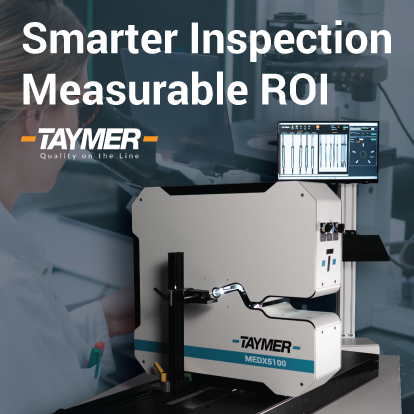
The Taymer MEDX-5100 is designed to automate offline inspection for catheters and similar medical components, addressing one of the most time-intensive stages of quality control. In manual workflows, catheter inspection can take several minutes per part and vary significantly depending on operator experience. The MEDX-5100 reduces this process to seconds while delivering consistent, 360-degree surface inspection.
Key capabilities include:
• Automated material handling for consistent part positioning
• High-resolution imaging for detailed surface analysis
• Real-time defect detection with size and location data
• Immediate visual feedback for operators
This allows quality teams to make faster, more informed decisions while improving documentation and communication across production and QA functions.
For balloon tubing and medical balloons, the same system enables reliable inspection of complex geometries and transparent materials—areas where manual inspection often falls short.
Defects Detected by Taymer
Taymer’s vision inspection systems are designed to identify a wide range of defect types relevant to medical manufacturing:
• Surface defects: scratches, dents, abrasions, micro-cracks
• Material defects: gels, bubbles, voids, holes, discoloration, contamination
• Dimensional and geometric variations: diameter changes, braid consistency, pick count
• Handling damage: defects introduced during transport or secondary processing
• Process variation: recurring defect patterns linked to upstream manufacturing conditions
By capturing these issues early and consistently, manufacturers can improve overall process control and product quality.
Where Measurable ROI Comes From
The ROI of automated medical inspection extends beyond labor reduction. The most significant gains come from combined improvements across multiple operational areas:
• Inspection time reduction: Decreasing inspection from minutes to seconds removes production bottlenecks
• Labor optimization: Reducing reliance on manual inspection lowers operator requirements and minimizes overtime while enabling skilled staff to focus on higher value tasks
• Scrap reduction: Improved defect detection and process visibility help reduce startup scrap, limit nonconforming product, and strengthen process control
• Capacity increase: Faster inspection and reduced downtime support higher line speeds and increased overall output
• Quality improvements: Fewer defects reaching customers lead to reduced complaints, less rework, and lower cost of poor quality (COPQ)
• Faster root-cause analysis: Image data and defect tracking accelerate identification and resolution of recurring issues
• Scalable inspection processes: Maintain consistent quality across higher production volumes
For medical manufacturers, these benefits scale across lines, shifts, and product families — creating compounding financial impact.
Traceability and Data-Driven Quality
A key advantage of Taymer’s vision inspection systems is the ability to generate and store visual inspection data. Instead of relying solely on pass/fail results, manufacturers gain access to:
• High-resolution inspection images
• Defect size and location data
• Inspection reports for audits and compliance
• Historical quality records for trend analysis
This supports stronger traceability, which is essential in medical device manufacturing for regulatory compliance and customer assurance.
More importantly, it enables a closed-loop quality process. Teams can correlate inspection data with upstream variables such as extrusion parameters, material batches, tooling conditions, and handling practices. This leads to faster identification of root causes and more effective continuous improvement.
From Cost Center to Competitive Advantage
Inspection has traditionally been viewed as a necessary cost. Taymer’s systems shift this perspective by transforming inspection into a source of operational and financial value.
By reducing labor dependency, minimizing scrap, increasing production capacity, and improving product quality, automated vision inspection becomes a strategic advantage rather than a constraint.
For medical manufacturers operating in highly regulated and quality-sensitive environments, this shift supports both compliance and long-term competitiveness.
Modernizing Medical Inspection with Taymer
As expectations for quality, traceability, and production efficiency continue to rise, manual inspection becomes increasingly difficult to justify as a primary method for critical medical components.
Taymer offers a practical, scalable solution through automated vision inspection technology tailored to medical manufacturing applications. By improving inspection speed, accuracy, and data availability, manufacturers can reduce costs, enhance quality, and achieve measurable ROI.